

Why Contract Cleaning Is Essential for Modern Commercial Facilities
Contract cleaning is a formal service arrangement where a business hires an outside company to handle all or part of its facility cleaning on a scheduled, recurring basis.
Quick answer: What is contract cleaning?
| Element | Details |
|---|---|
| What it is | A written agreement for professional cleaning of commercial facilities |
| Who uses it | Offices, medical facilities, schools, warehouses, retail spaces |
| What’s included | Daily janitorial, floor care, restroom sanitation, window cleaning, porter services |
| Key benefit | Consistent, expert cleaning without the cost and complexity of in-house staff |
| How it’s managed | Fully outsourced programs or supplemental staffing added to existing teams |
Keeping a commercial facility clean is not just about appearances. It directly affects employee health, tenant satisfaction, regulatory compliance, and the long-term value of the building itself.
The demand for professional cleaning reflects this reality. The U.S. janitorial services industry is projected to reach $78.5 billion in revenue, growing steadily as more businesses recognize that cleaning is a core operational function, not an afterthought.
For facility managers, the challenge is not simply finding someone to mop floors. It is finding a provider with the right training, technology, insurance, and processes to deliver consistent results across every inch of your space, every single day.
Red Coats has provided professional contract cleaning services to commercial, institutional, and industrial facilities since 1960, growing from a 12-person team into one of the largest family- and woman-owned cleaning companies in the United States, now serving approximately 175,000,000 square feet daily. That depth of experience shapes everything in this guide.
What is Contract Cleaning and How Does It Work?
Commercial contract cleaning is a structured service model designed to keep facilities in top operating condition. It involves heavy duty, highly regulated cleaning protocols tailored to high traffic business environments.
When you enter a contract cleaning agreement, you establish a partnership with a professional service provider. This agreement outlines the exact scope of work, the frequency of each task, the cleaning standards required, and the pricing structure.
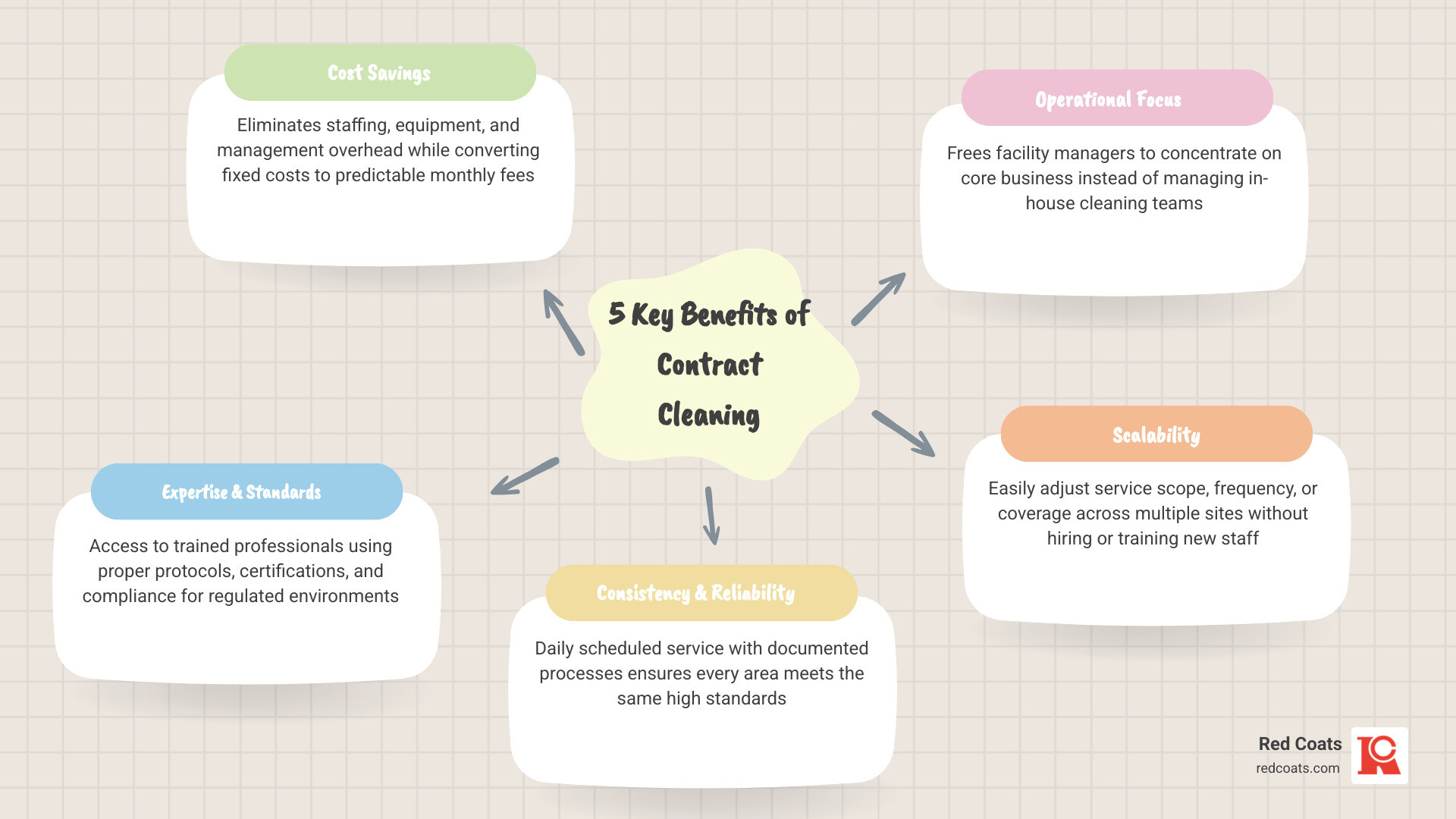
The primary goal of these agreements is facility maintenance and operational efficiency. Instead of worrying about whether the restrooms are stocked or the lobby floors are buffed, your management team can focus entirely on your core business operations.
Contract Cleaning vs. In-House Operations
Many businesses wonder whether they should hire an in-house cleaning team or outsource the work to a professional contractor. While managing cleaning internally might seem like a way to retain control, it quickly introduces significant management overhead and hidden costs.
When you manage cleaning in-house, you are responsible for:
- Recruiting, background checking, and training janitorial staff.
- Paying payroll taxes, benefits, and workers’ compensation insurance.
- Managing shift call-outs, vacations, and employee turnover.
- Procuring expensive commercial grade equipment, such as HEPA backpack vacuums, floor scrubbers, and specialized chemicals.
By outsourcing to a professional provider, you eliminate these administrative burdens. The contractor handles all staffing, equipment procurement, and daily supervision. Furthermore, professional providers bring specialized expertise that in-house teams rarely possess, ensuring that your building remains safe and sanitary.
To understand why having a clean workspace is so critical to your bottom line, explore our article on The Importance of a Clean Workspace: Why Your Boss Cares.
Fully Managed Programs vs. Supplemental Staffing
Contract cleaning services are generally structured in two ways: fully managed outsourced programs or supplemental staffing. Choosing the right structure depends on your existing facility operations.
- Fully Managed Programs: In this model, the contract cleaning provider takes complete ownership of your facility’s cleanliness. We provide the supervisors, the front-line cleaners, the equipment, and the quality assurance software. This is a turnkey solution that requires virtually zero daily management from your team.
- Supplemental Staffing: If you already have an in-house cleaning crew but struggle to keep up with high traffic demands, special events, or specialized tasks like deep floor care, you can use supplemental staffing. In this scenario, we provide trained professionals, such as daytime porters, to work alongside your existing team and fill operational gaps.
| Feature | Fully Managed Programs | Supplemental Staffing |
|---|---|---|
| Management Overhead | Extremely low (handled entirely by the provider) | Moderate (requires coordination with internal staff) |
| Equipment & Supplies | Provided and maintained by the contractor | Can be provided by either party |
| Staffing Flexibility | High (contractor covers all absences and turnover) | High (easily scales during peak seasons) |
| Best For | Businesses wanting to fully outsource facility care | Businesses with existing but understaffed internal teams |
To learn more about how commercial agencies structure these options, read our guide on 5 Common Questions About Commercial Cleaning Agencies Answered.
Industries and Facilities Served by Professional Cleaners
Every building has its own unique operational rhythm, foot traffic patterns, and cleanliness standards. A reputable contract cleaning provider does not offer a one-size-fits-all solution. Instead, we design customized cleaning programs that match the specific needs of your facility.
Commercial Offices and Corporate Headquarters
From multi-tenant high rise office buildings to sprawling corporate headquarters, maintaining clean workspaces is essential for employee productivity and tenant retention. Office cleaning typically includes daily vacuuming, trash and recycling removal, restroom disinfection, dusting of common areas, and specialized lobby floor care.
In competitive real estate markets, a clean building is a major leasing advantage. If you are looking for municipal opportunities or corporate partnerships in the Mid-Atlantic, you can review current Cleaning contracts, bids, and opportunities in Virginia – CleanWork to see what local organizations require.
Healthcare Facilities and Medical Offices
Medical cleaning requires an entirely different level of precision and compliance. Outpatient clinics, dental offices, and medical centers must adhere to strict pathogen reduction protocols to prevent healthcare-associated infections.
Cleaners working in these environments must be trained in bloodborne pathogen safety, proper personal protective equipment (PPE) usage, and contact times for EPA-registered, hospital-grade disinfectants.
If you are a professional looking to enter this rewarding field in the D.C. metro area, you can search for 1,000+ Contract Cleaning jobs in Washington – LinkedIn to find positions that require these specialized skills.
Industrial, Logistics, and Retail Spaces
Industrial facilities, manufacturing plants, and distribution warehouses have massive footprints that require specialized heavy duty equipment. High traffic environments like retail stores and logistics hubs demand continuous day porter services to keep up with spills, trash accumulation, and restroom sanitization.
These environments also require strict adherence to OSHA safety standards to prevent slips, trips, and falls on active warehouse floors.
Key Benefits of Outsourcing to National vs. Local Providers
When selecting a contract cleaning partner, businesses must decide between hiring a local boutique cleaning service or partnering with a provider that offers national-scale resources.
Scale and Consistency of National Providers
For businesses with multiple locations across different states, partnering with a larger provider offers unmatched advantages:
- Service Consistency: We implement standardized training programs across all regions, ensuring that your office in Florida meets the exact same high standards as your facility in North Carolina.
- Resource Availability: Larger providers have deep supply chains, meaning we never run out of critical cleaning chemicals, paper products, or backup equipment.
- Dedicated Account Management: Instead of dealing with five different local companies, you get a single point of contact to manage billing, scheduling, and quality auditing across your entire portfolio.
To understand how regional scale benefits your bottom line, read our detailed analysis on Why Your Business Needs Certified Janitorial Services from Florida to NC.
Local Expertise and Regional Compliance
While national scale is important, local operational knowledge is equally crucial. Different states and municipalities have unique labor laws, environmental regulations, and procurement rules.
For example, public buildings and state contracts often require compliance with specific prevailing wage rates and local vendor portals. Businesses looking to bid on public sector janitorial work in the Carolinas can explore opportunities via the Janitorial Cleaning Services – North Carolina electronic Vendor Portal .
A great contract cleaning partner combines the robust infrastructure of a large regional provider with deep roots in local communities.
Certifications, Training, and Technology in Modern Janitorial Services
Modern commercial cleaning is a highly technical field that relies on scientific principles, rigorous certifications, and advanced software to ensure quality and compliance.
How to Choose the Right Contract Cleaning Provider
Selecting the wrong cleaning provider can lead to dirty facilities, high tenant complaints, and even legal liabilities. Here is how to properly evaluate a contract cleaning company.
Essential Legal and Insurance Requirements
Before signing any contract, you must verify that the provider is fully licensed, bonded, and insured. Never accept verbal assurances, always request official certificates of insurance (COI) that include:
- General Liability Insurance: Protects your business if a cleaner accidentally damages your property, such as spilling a chemical on an expensive floor.
- Workers’ Compensation Insurance: Protects you from being held liable if a cleaning technician is injured while working in your facility.
- Surety/Janitorial Bonds: Protects your business against theft or loss of property.
- Local Business Licenses: Ensures the company is legally registered to operate in your specific city and state.
If you are a cleaning business owner looking to structure your bids to meet these high standards, read our guide on How to Win Janitorial Bids and Clean Up the Competition.
Pricing Models and Service Frequency
Contract cleaning pricing is typically calculated using one of two methods:
- Square Footage Rates: The provider assesses the total cleanable square footage, the flooring types, and the density of the workspaces to calculate a price per square foot.
- Monthly Fixed Fees: A flat monthly rate that covers a defined scope of work, making budgeting highly predictable for facility managers.
The frequency of your service is determined by your building’s occupancy, foot traffic, and industry requirements. A medical clinic may require deep cleaning seven nights a week, while a professional office suite might only need service three nights a week.
To explore what regional opportunities and pricing structures look like in the Southeast, you can review Cleaning contracts, bids, and opportunities in Florida – CleanWork .
Verifying Performance Through Audits and KPIs
A reliable contract cleaning agreement must include clear Key Performance Indicators (KPIs) and a structured auditing process. Common KPIs include:
- Overall Satisfaction Score: Maintaining a minimum audit score of 95% or higher.
- Response Time: Resolving non-emergency complaints within 24 hours and emergency requests within 1 to 2 hours.
- Staff Consistency: Keeping employee turnover low to ensure that the same trained cleaners become familiar with your building’s security protocols and unique layout.
Frequently Asked Questions About Commercial Janitorial Services
What is included in standard commercial contract cleaning?
A standard commercial cleaning program typically includes daily trash and recycling removal, dusting of desks and common areas, vacuuming carpets, mopping hard floors, comprehensive restroom sanitization, and cleaning breakrooms or kitchenettes. Specialized tasks like carpet shampooing, window washing, and hard floor buffing are usually scheduled as periodic project work.
How do providers handle emergency or urgent cleaning requests?
Reputable commercial cleaners provide 24/7/365 emergency support. Whether you experience a burst pipe, an unexpected spill, or a contamination event that requires rapid sanitization, your provider should have a mobile crew ready to dispatch immediately. At Red Coats, urgent service delivery is one of our core operational strengths.
Conclusion
A successful contract cleaning program is built on trust, transparency, and a commitment to consistent quality. When you outsource your facility’s care to an experienced, certified partner, you protect your physical assets, support your employees’ health, and free up valuable management time.
Red Coats is ready to be that trusted partner. With over six decades of industry leadership, Green Seal GS-42 certification, and a dedicated team serving DC, MD, VA, NC, SC, FL, and TX, we deliver customized commercial cleaning solutions that put your peace of mind first.
Ready to elevate your facility’s cleanliness? Explore our comprehensive Red Coats Services or contact us directly at Red Coats to request a customized service proposal today.