

What to Look for in a Commercial Floor Cleaning Contract
A strong commercial floor cleaning contract should clearly define the floor types covered, cleaning frequency, methods and equipment, safety expectations, quality checks, and who is responsible for repairs or replacement equipment. It should also state how the provider will handle spills, high-traffic areas, wastewater, chemicals, and scheduled deep cleaning.
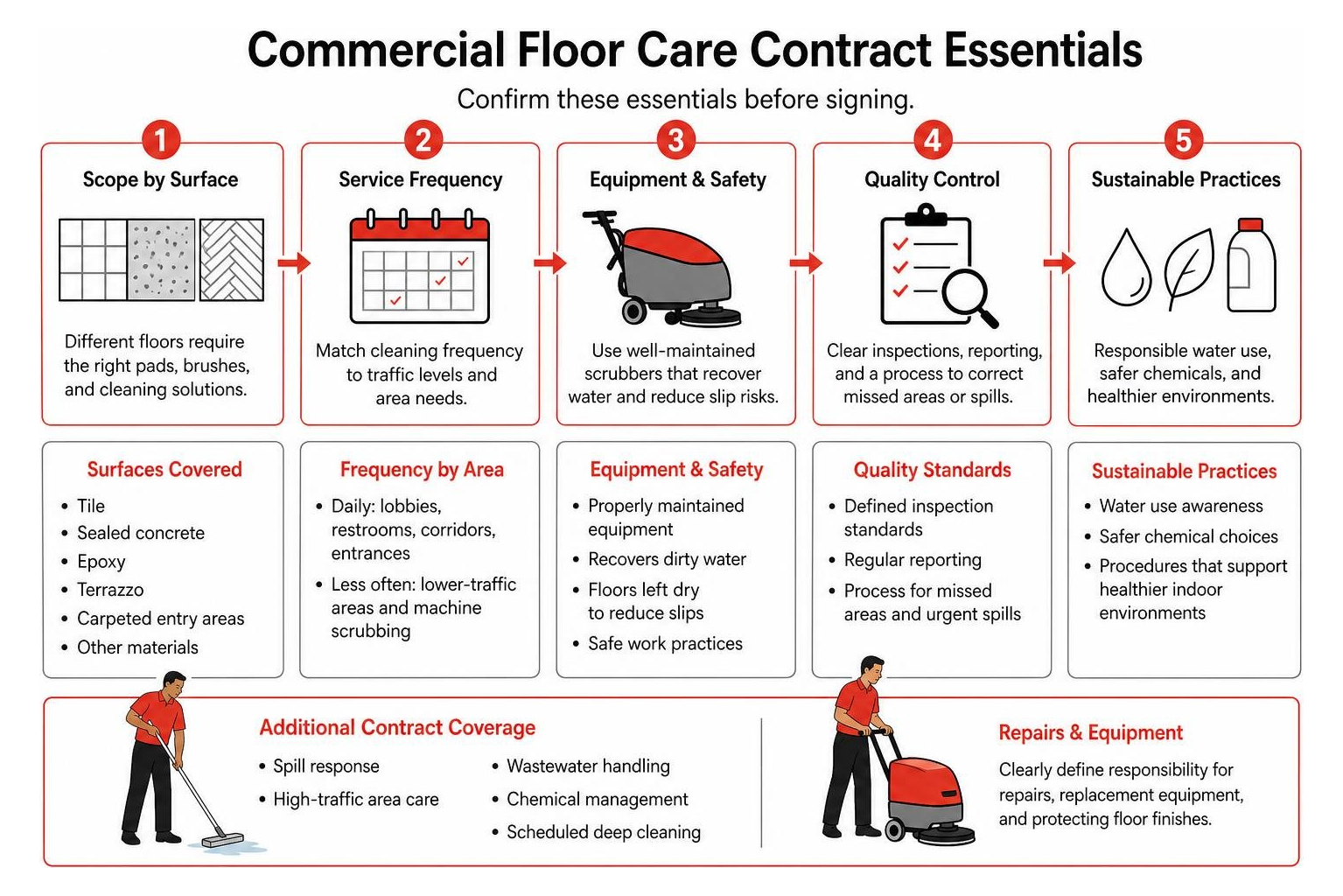
Before signing, confirm these essentials:
- Scope by surface: Tile, sealed concrete, epoxy, terrazzo, carpeted entry areas, and other materials may need different pads, brushes, and cleaning solutions.
- Service frequency: Daily attention may be needed in lobbies, restrooms, corridors, and entrances, while lower-traffic areas may need less frequent machine scrubbing.
- Equipment and safety: Ask whether the service uses properly maintained scrubbers that recover dirty water and leave floors dry enough to reduce slip risks.
- Quality control: Require clear inspection standards, reporting, and a process for correcting missed areas or urgent spills.
- Sustainable practices: Review water use, chemical choices, and procedures that support healthier indoor environments.
The right equipment matters, but the contract matters just as much. A walk-behind scrubber may be the practical choice for tight office corridors, while larger open spaces may need ride-on equipment or other high-productivity methods. For mixed flooring, multi-surface extraction equipment can reduce tool changes, but the provider should still specify how it will protect finishes and clean carpets safely.
Red Coats has provided commercial floor cleaning and facility services since 1960, serving offices, medical buildings, schools, industrial sites, and other commercial facilities across the DC metro area and Southeast. With more than 8,000 team members cleaning approximately 175 million square feet each day, we understand that dependable floor care starts with clear expectations and accountable service.
Key Equipment Standards in Commercial Floor Cleaning Contracts
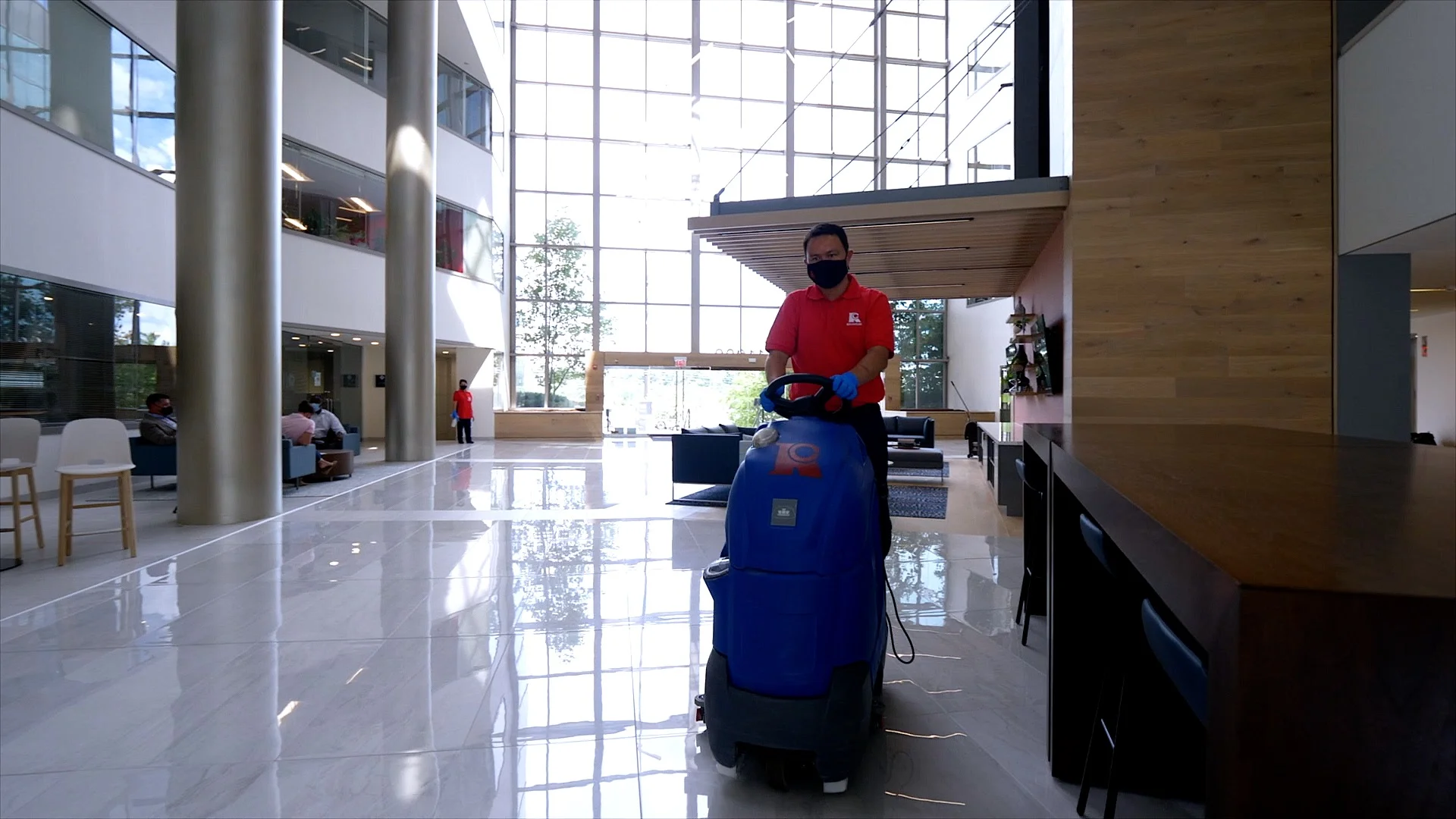
When reviewing a janitorial service agreement, evaluating the contractor’s machinery fleet is essential. The type, age, and maintenance standards of the equipment directly dictate cleaning productivity, surface longevity, and building safety. A quality contract outlines exact machinery categories, preventing scenarios where underpowered equipment leaves high-traffic areas dirty or wet.
Cleaning machinery must match the physical layout of your facility. Facilities with vast open corridors require different equipment than multi-tenant office buildings with narrow hallways, doorways, and tight turns around workstations.
Contract terms should also address power delivery. Traditional corded units offer continuous runtimes but introduce tripping hazards and limit cleaning ranges based on outlet availability. Modern lithium-ion cordless floor scrubbers eliminate trip hazards, streamline navigation through congested office suites, and decrease total cleaning cycle times.
Walk-Behind, Ride-On, and Robotic Scrubbers
Selecting the ideal machinery type balances square footage thresholds, layout complexity, and runtime requirements:
- Walk-Behind Scrubbers: Best suited for compact or obstacle-rich zones such as office restrooms, breakrooms, and mid-sized entryways. Available in cleaning path widths ranging from 15 to 21 inches, these units offer high maneuverability around partitions and furniture.
- Ride-On Scrubbers: Essential for large facilities such as distribution hubs, medical centers, and airport terminals. Ride-on units cover significant square footage per hour, reducing operator fatigue and increasing labor productivity across expansive footprints.
- Autonomous Robotic Scrubbers: Autonomous units navigate predetermined routes via optical and LiDAR sensors. They handle large, repetitive open areas consistently, allowing cleaning technicians to focus on detailed touchpoint sanitation, edge cleaning, and specialized surface care.
Multi-Surface Extraction and Advanced Scrubbing Technologies
Modern commercial facilities rarely feature a single flooring type throughout. High-performance multi-surface cleaning systems allow technicians to transition seamlessly between sealed hard floors, entryway mats, and commercial carpets without swapping machinery.
Advanced technologies enhance soil suspension while conserving natural resources. Systems utilizing nanobubble technology create millions of microscopic bubbles per minute to lift and emulsify soil without requiring harsh detergents. Extended scrubbing systems filter and recycle cleaning solution during operation, reducing fresh water intake by up to 50%. Dual-action extraction platforms utilize water-based aquatic air scrubbing filtration to capture airborne particulate matter and fine dust, eliminating the waste associated with disposable paper filters.
Evaluating Equipment Maintenance, Costs, and Efficiency
A transparent floor care contract protects property owners from service disruptions caused by broken machinery. When machinery breaks down without a contractually defined backup plan, soil accumulates, floor finishes degrade, and safety risks escalate.
Evaluating Commercial Floor Cleaning Equipment in Service Agreements
Contract language should outline daily preventative maintenance routines, including tank rinsing, squeegee inspections, and filter care. Cleaners must maintain vacuum seals and clean recovery tanks daily to prevent foul odors, bacterial growth, and streaks.
When choosing the best commercial cleaning company for your property, review how equipment performance compares against traditional manual cleaning methods:
| Method / Equipment Type | Soil Removal Efficacy | Hourly Productivity (Sq. Ft.) | Water & Chemical Waste | Traction & Slip Safety |
|---|---|---|---|---|
| Traditional Mop & Bucket | Low (redistributes surface dirt) | 2,000 to 4,000 | High water usage; high chemical residue | Wet surfaces create slip-and-fall risks |
| Auto Scrubbers (Walk-Behind / Ride-On) | High (mechanical agitation & vacuum recovery) | 10,000 to 30,000 | Up to 50% less water; controlled chemical dosing | Immediate squeegee drying; safe traction |
| Multi-Surface Extractors | Extreme (up to 99.8% targeted soil removal) | 20,000+ hard floor & carpet | Aquatic filtration; minimal chemical dependency | High-traction NFSI certified recovery |
High-performance multi-surface extraction systems can lower ongoing maintenance costs by up to 65% compared to complex traditional machinery. Ensure your contract specifies replacement timeframes if a primary machine requires off-site repair.
Soil Removal and Slip-Resistance Safety Standards
Manual mopping often spreads dirt across the floor, leaving dirty residue along baseboards and inside tile grout lines. Professional extraction equipment removes up to 60 times more soil than traditional mops, capturing up to 99.8% of targeted contaminants in rigorous testing.
Removing soil and chemical residues directly improves facility safety. When drafting safety requirements, reference a squeaky clean guide to cleaning the workplace safely to establish clear standards.
Verify that your cleaning provider utilizes equipment certified by the National Floor Safety Institute (NFSI) for high traction. NFSI-certified equipment restores dynamic friction coefficients to safe levels immediately after cleaning, mitigating slip-and-fall liabilities. Furthermore, non-abrasive extraction methods help preserve protective surface coatings, generating up to 25% higher gloss meter readings on polished surfaces compared to abrasive scrubbing pads.
Matching Cleaning Methods to Commercial Flooring Surfaces
Commercial facilities utilize a wide range of flooring materials, each with unique chemical sensitivities and mechanical tolerances. Using the wrong brush or overly aggressive pad can scratch epoxy coatings, strip wax coats, or dull natural stone.
Brush and Pad Specifications for Commercial Floor Cleaning
A complete commercial floor cleaning agreement should specify the pad colors, brush grit levels, and down-pressure metrics assigned to each distinct surface in your building.
To keep high-traffic tiled lobbies looking their best, facility managers can review scrub and shine your guide to commercial tile maintenance for detailed care standards.
- Polished Concrete & Terrazzo: Requires ultra-soft diamond-impregnated polishing pads or non-abrasive soft nylon brushes. High down-pressure with aggressive grit can destroy the polished surface and expose porous aggregate.
- Resinous Epoxy: Sensitive to harsh solvent-based detergents and coarse pads. Requires soft white or red polishing pads with neutral pH cleaners to prevent scratching the protective gloss coat.
- Quarry Tile & Textured Ceramic: Requires cylindrical brushes that rotate to dig deep into grout lines without damaging tile edges.
- Commercial Carpet: Requires low-moisture cylindrical brush extraction to lift matted fibers and extract soil without over-wetting backing materials.
Sustainable and Chemical-Free Cleaning Practices
Modern facility managers prioritize environmental sustainability alongside clean surfaces. Sustainable cleaning protocols improve indoor air quality, eliminate volatile organic compound (VOC) off-gassing, and reduce chemical wastewater discharges into municipal drainage systems.
For an in-depth review of sustainable cleaning methods, read our guide on eco friendly shine your guide to green commercial cleaning.
At Red Coats, we operate Global Care, our Green Seal GS-42 Certified Cleaning Program. This program is designed to comply with standards established by the U.S. Green Building Council (USGBC) and has helped our clients obtain LEED, Fitwel, and WELL certifications for their properties. Implementing low-water equipment, non-toxic cleaning agents, and high-efficiency filtration preserves your flooring investments while supporting building wellness goals.
Essential Contract Terms for Commercial Facility Managers
A comprehensive commercial cleaning contract eliminates ambiguity by establishing measurable service level agreements (SLAs), detailed scopes of work, and transparent pricing models.
Service Frequency, Scope, and Quality Assurance
Floor care scopes must distinguish daily touchpoints from periodic deep restoration. For guidance on evaluating regional service delivery, see how to choose the best commercial cleaning services fredericksburg va offers.
Ensure your contract defines:
- Daily Scope: Day porter services for urgent spill response, entryway mat vacuuming, walk-off zone dust mopping, and automated scrubbing in main lobbies.
- Periodic Deep Care: Scheduled quarterly or semi-annual deep scrubbing, high-traction finish buffing, grout extraction, and carpet hot-water extraction.
- Audits and Key Performance Indicators (KPIs): Regular joint inspections using digital logging tools, gloss meters, and ATP hygiene swab testing.
- Emergency Response Timeframes: Guaranteed response windows for inclement weather tracking, unexpected plumbing leaks, or hazardous material cleanups.
In-House Equipment Acquisition vs. Outsourced Contracts
Property managers frequently evaluate whether to purchase floor care equipment for in-house staff or outsource cleaning operations entirely to a commercial cleaning partner.
Acquiring equipment in-house introduces high capital expenditures and ongoing administrative burdens. Commercial scrubbers can cost thousands of dollars to purchase, with smaller walk-behind units starting around $3,199 to $5,249. Even flexible lease-to-own programs, which often require upfront deposits near $399 with monthly payments around $134, present long-term challenges:
- Internal teams remain responsible for equipment storage, battery watering, squeegee replacements, and unexpected motor failures.
- In-house custodial turnover requires ongoing training on safety procedures, chemical dilution, and machine mechanics.
- If an owned or leased machine breaks down, the property manager must arrange service repairs, during which cleaning stops.
Outsourcing to an experienced commercial contractor transfers equipment liability, maintenance overhead, and technician training entirely to the provider. The facility benefits from modern machinery fleets, certified operators, and consistent operating budgets.
Frequently Asked Questions about Commercial Floor Care
How do automatic floor scrubbers compare to manual mopping?
Automatic floor scrubbers apply clean cleaning solution, agitate dirt mechanically with rotating pads or brushes, and immediately vacuum dirty wastewater into a recovery tank. Manual mopping frequently spreads suspended dirt across surfaces, leaving residues that dull finishes and harbor bacteria. High-performance mechanical scrubbers extract up to 60 times more soil and recover over 95% of moisture, leaving floors dry and safe immediately.
What surface types require specialized scrubber pads and chemicals?
Polished concrete, unsealed terrazzo, luxury vinyl tile (LVT), and resinous epoxy all require tailored care. Polished concrete and terrazzo need fine-grit diamond pads to prevent micro-scratching. Resinous epoxy coatings require neutral pH cleaners paired with soft white or red buffing pads to avoid chemical clouding. Hard surfaces with deep grout lines require cylindrical brushes rather than flat disc pads to extract dirt from recesses.
Conclusion
A well-structured commercial floor care contract provides your property with consistent cleanliness, extended flooring life, and verified slip resistance. By establishing clear standards for equipment capabilities, maintenance protocols, surface-specific techniques, and quality assurance metrics, building owners and facility managers can protect their properties from costly premature replacements and safety liabilities.
Red Coats delivers comprehensive facility management, advanced machinery fleets, and skilled janitorial teams across the District of Columbia, Maryland, Virginia, North Carolina, South Carolina, Florida, and Texas. Through Global Care, our Green Seal GS-42 Certified Cleaning Program, we meet rigorous U.S. Green Building Council (USGBC) standards, helping our clients obtain LEED, Fitwel, and WELL certifications for their buildings.
To partner with an experienced janitorial provider that keeps your facility safe, sustainable, and immaculate, explore our commercial cleaning and facility services today.